The Chinese Clan Networks Behind the World’s Biggest Electronics Market
This is the third article in a series on China’s southern Chaoshan region, exploring the history, culture, and identities behind its recent resurgence in the spotlight. Read Part 1 and Part 2.
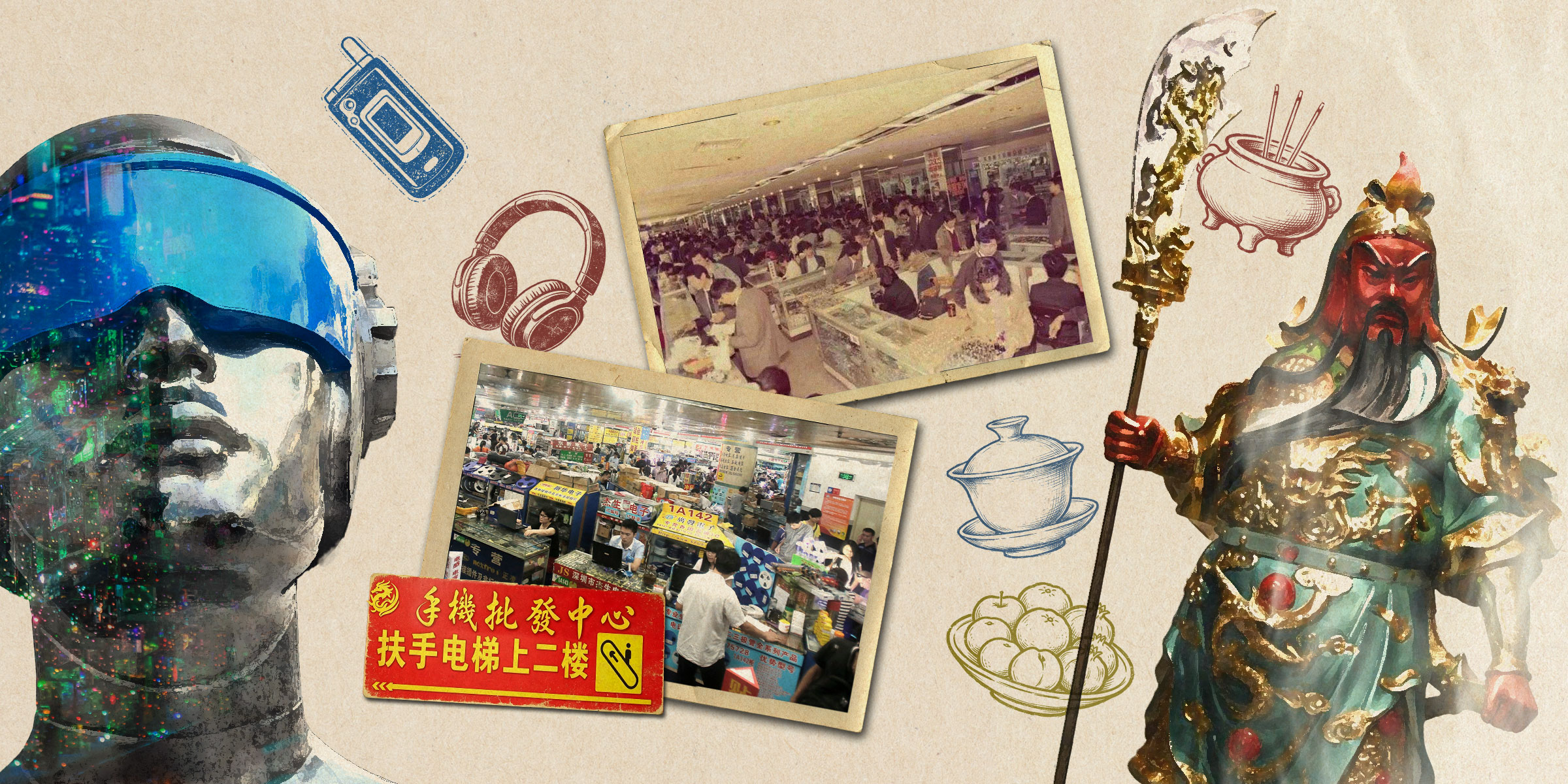
If you wanted to find a place in China that looked as though it had been lifted straight from a science-fiction novel, chances are someone would point you to Huaqiangbei, an area in the country’s southern tech hub of Shenzhen. Known as “China’s No. 1 Electronics Street,” it is home to the world’s largest electronics market. Here, customers weave through narrow, maze-like corridors in search of virtually every electronic product imaginable, from the latest smartphones, drones, and robots to the precision capacitors and resistors needed to make them.
And yet, there is one thing that pulls you out of this cyberpunk world and back to reality: the complete tea sets displayed on the counters of nearly every store. If you happen to understand Chinese dialects, you may notice something else. The merchants are not speaking Mandarin, or even Cantonese, the local dialect typically used across Guangdong province, which encircles Shenzhen to the north. Instead, they are conversing in the far less familiar Chaoshan dialect.
According to estimates, around 70% to 80% of Huaqiangbei’s merchants come from the Chaoshan region of eastern Guangdong, also known as Teochew, a culturally distinct area centered on the cities of Shantou, Chaozhou, and Jieyang. These migrants brought with them not only their dialect and tea sets, but also their local cuisine. Walking through the Huaqiangbei area, it is impossible to miss the many restaurants bearing the names of places in Chaoshan. Together, they testify to the dominance of the Chaoshan community in Huaqiangbei.
Chaoshan people have long been renowned across China for their business acumen, though they are perhaps even better known for their strong clan organizations, well-preserved customs, and tightly knit kinship networks. Outside Guangdong, however, few people associate them with the cutting-edge electronics industry. So how did they come to dominate the world’s largest electronics market?
In fact, Huaqiangbei has not always been home to such a large Chaoshan community. The market’s history dates back to September 1979, when Guangdong decided to relocate three military-industrial factories from the province’s mountainous north to Shenzhen. Located next to Hong Kong, the city was expected to kick-start the electronics industry through the “three imports and one compensation,” or sanlai yibu model, which paired foreign investment, technology, and components with local manufacturing.
After the three factories were merged and restructured, the new enterprise was named Huaqiang Electronic Industry Company, with “huaqiang” conveying the idea of a strong and prosperous China. The factory complex was divided by a road, with the northern section designated as the industrial zone. The area became known as “Huaqiangbei” – literally meaning “Huaqiang North.”
At the time, the city of Shenzhen — previously known as Bao’an County — had just been born, and had a population of only a few tens of thousands. Today, by contrast, Shenzhen is a sprawling megacity with around 18 million inhabitants.
In 1980, Shenzhen was officially designated a special economic zone, giving it greater freedom to experiment with market reforms. Two years later, the Ministry of Electronics Industry was established, and China began vigorously promoting the development of its electronics sector. Shenzhen also designated Huaqiangbei as a hub for the industry’s growth. At the same time, enterprises affiliated with government ministries moved in, along with companies that had been military manufacturers whose expertise could be adapted to civilian electronics production. Hong Kong and foreign entrepreneurs also recognized its potential. Construction soon boomed in Huaqiangbei, with industrial buildings rising in anticipation of more companies arriving.
It was on these construction sites that the first wave of Chaoshan migrants arrived. The Chaoshan region has a long history of migration and is known for its tradition of “chain migration,” whereby migrants establish themselves in a new location before being joined by relatives and neighbors from their hometowns and nearby villages. When someone from Chaoshan arrives in Shenzhen, a relative has often already arranged accommodation and helped secure a job.
The turning point that enabled Chaoshan people to become so dominant in Huaqiangbei came in 1986. In the mid-1980s, under the leadership of the Ministry of Electronics Industry, Shenzhen had merged more than 100 small- and medium-sized electronics enterprises into Shenzhen Electronics Group, later known as SEG Group. The new conglomerate benefited from scale, but it remained subject to many of the constraints of the planned economy. Most advanced components could not be produced domestically and had to be imported. Under the policies of the time, importing these components required government approval, as did obtaining the foreign currency needed to pay for them, a process that could take months. By the time the purchase permission and foreign-exchange approval were both granted, orders had often expired, causing firms to miss market opportunities.
To overcome these bottlenecks, SEG Group proposed creating China’s first specialized market for electronic components in Huaqiangbei in 1986, modeled on Tokyo’s Akihabara Electric Town. This market, later known as SEG Electronics Market, operated without requiring purchase approval documents, allowing goods to be sold directly.
The low-barrier business model proved almost tailor-made for Chaoshan entrepreneurs.
Securing advanced electronic components depended above all on overseas connections, an area in which the Chaoshan community excelled. The region has a long tradition of outward migration, with family networks stretching across Hong Kong and throughout Southeast Asia. Chaoshan merchants frequently used these networks to import electronic components through Hong Kong’s free port, sometimes operating in legal gray areas, before reselling them to factories on the mainland.
Apart from overseas markets, Chaoshan merchants in Shenzhen also had access to a more discreet source of supply: Guiyu, a town in Shantou’s Chaoyang District.
In the 1980s, Guiyu grew into the world’s largest electronic-waste recycling market. Residents imported container loads of e-waste from overseas, which were then sorted, dismantled, and refurbished in small workshops to recover components such as chips, resistors, capacitors, and connectors. If small- and medium-sized factories were unable to secure components through regular channels, they could rely on this imported “foreign waste.” Obtained by Chaoshan traders through relatives in Hong Kong, it provided a critical lifeline when supplies ran short. To this day, traders can still be heard in Huaqiangbei distinguishing between “boxed” components in their original packaging and cheaper “loose” parts sourced from surplus, recycled, or refurbished stock. The latter also refers to parts that are cheaper but less reliable.
Chaoshan merchants in Shenzhen also transplanted the mutual-aid systems popular among overseas Chinese communities, including clan-based credit arrangements, informal arbitration mechanisms, and hometown associations. Anyone speaking the Chaoshan dialect is likely to be immediately accepted as “one of us.” Market logic often gives way to kinship ties and mutual obligations. Urgent deals can be completed with a simple spoken promise, while suppliers facing financial difficulties can borrow from wealthy relatives without collateral, creating a highly exclusive informal credit system. Information about price fluctuations, excess inventory, and unreliable sellers also circulates among Chaoshan merchants in tea houses, restaurants, and social media groups, giving them a significant competitive advantage. In this way, growing up in a Chaoshan migrant family provides access to these networks that newcomers can spend years trying to build.
This extensive mutual-aid network, combined with an inherited understanding of business and a willingness to take risky gambles, allowed Chaoshan merchants to thrive in Huaqiangbei. Increasingly, young people from Chaoshan have come to believe that even if school is not their strong suit, they can always move to Huaqiangbei, connect with relatives, rent a “one-meter counter,” and pursue their dreams of getting rich.
These individual decisions have also transformed Shenzhen’s cultural landscape. Urban villages such as Futian Village and Chiwei began as rural settlements before being swallowed by Shenzhen’s rapid urban expansion. Today, they have become “Chaoshan enclaves,” where restaurants serve dishes so specific they can be traced to individual villages, and different varieties of the Chaoshan dialect can be heard on the streets.
In some ways, this follows the old pattern of migration to Nanyang, the historical Chinese term for Southeast Asia. Young people rely on chain migration and their clan networks, but their destination is now Shenzhen rather than Bangkok or Singapore.
However, Huaqiangbei is not as bustling as it once was. The rise of e-commerce, along with transportation pressures in the area, has reduced foot traffic to this brick-and-mortar electronics market. Meanwhile, Chaoshan merchants have begun shifting toward cross-border e-commerce, opening stores on platforms such as Amazon and diversifying into categories including imported food and cosmetics. After years of crackdowns on illegal imports and environmental remediation efforts, Guiyu’s recycling industry has been incorporated into a regulated industrial park. However, secondhand products and overseas components still find their way onto the counters of Huaqiangbei.
Within this vast network, both visible and hidden, Chaoshan merchants are already moving into new industries, continuing a tradition of pursuing opportunity wherever it emerges.
Translator: David Ball; portrait artist: Wang Zhenhao.
(Header image: Visuals from VCG, edited by Fu Xiaofan/Sixth Tone)